
Ozark County Arrest Records and Charges
Ozark County arrest records are created by law enforcement when a person is arrested, booked, or tied to an incident record. They may involve the sheriff, jail, arresting officer, incident report, booking status, warrant service, or custody transfer. Those records do not always mean a criminal case has been filed, and they do not by themselves prove a conviction.
Court charges after arrest are different. The prosecutor reviews law-enforcement reports and decides whether to file formal state charges. Once filed, the charge becomes part of the Ozark County criminal court case in Missouri's circuit court system. The full case file, including pleas, motions, disposition, and sentence, belongs in Ozark County criminal court records. Current custody questions, jail placement, and booking confirmation belong with the sheriff or jail access chain, not the court charge docket.
| Record Type | Created By | What It Usually Answers |
|---|---|---|
| Arrest or incident record | Sheriff, patrol, or other law-enforcement agency. | Whether an arrest, incident, or law-enforcement action was recorded. |
| Booking or custody record | Jail or detention facility. | Whether a person is in local, ICE, DOC, or other custody. |
| Court charge record | Prosecutor filing in Circuit Court. | What formal charges were filed and their current case status. |
| Criminal case record | Circuit Clerk and Recorder of Deeds. | Pleas, hearings, disposition, sentence, costs, and court orders. |
Find Ozark County Arrest Records
The practical search chain starts by identifying the question. For court charges after arrest, use Missouri Case.net and search the defendant name or case number. For arrest, incident, jail, warrant-service, or custody details, contact the Ozark County Sheriff's Office and jail. Research did not locate an official Ozark County public jail roster, so third-party jail pages should not be treated as verified local sources.
- Search Case.net by defendant name or case number to see whether formal charges were filed in Ozark County.
- Open the matching court case and review the charge list, charge level, docket entries, bond, and current status.
- Call the Circuit Clerk and Recorder of Deeds for certified charge documents, older case files, or unclear docket entries.
- Call the sheriff or jail for arrest, booking, custody, warrant-service, or incident-record questions.
- Use MSHP for criminal-history checks or patrol-created records when the question is statewide or patrol-specific.
For jail roster and custody details, the related access path is the county inmate page, but the research gap is important: no official Ozark County public jail roster was found. ICE facility materials state that detainee information can be requested by calling the sheriff's phone and using option 2, but local custody should still be confirmed before travel or payment.
Charges After Arrest in Ozark County
Charges after arrest become court records when the prosecutor files a charging document. Missouri uses county prosecuting attorneys rather than district attorneys. The research file lists Ozark County Prosecuting Attorney Lee Pipkins through the Missouri Association of Prosecuting Attorneys directory and gives a DPS contact of P.O. Box 67, Gainesville, MO 65655, phone 417-679-4649.
The Missouri prosecutors directory is one of the manifest image sources for this page.
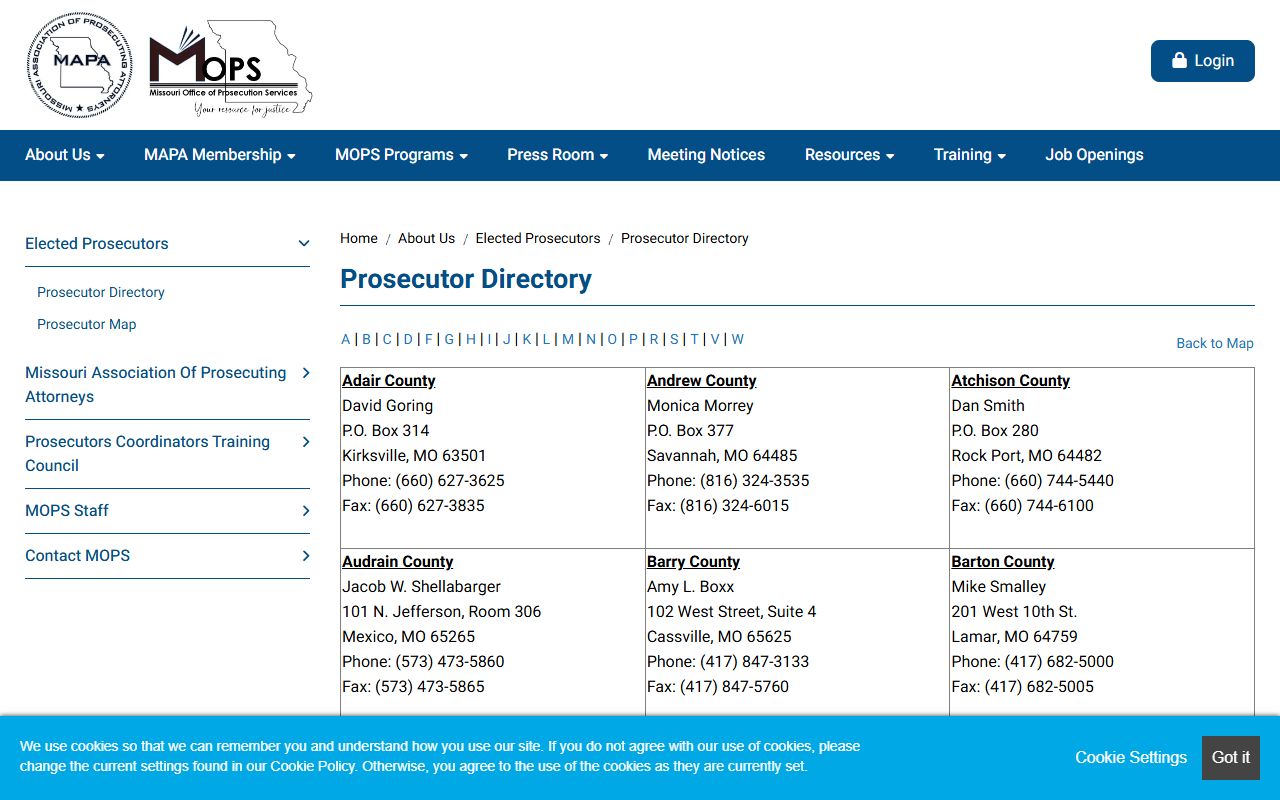
That source supports the local charge-filing role: the prosecutor is the office that decides whether law-enforcement reports become formal court charges.
| Charging Document | Who Files or Returns It | How It Fits the Court Charge Record |
|---|---|---|
| Complaint | Often prepared through law enforcement or prosecutor review. | Can start a criminal case and state the alleged offense. |
| Information | Filed by the prosecutor. | Common formal charging document in Missouri criminal cases. |
| Indictment | Returned by a grand jury. | Formal charge route for certain matters when used. |
Ozark County Charge Status Terms
Charge status can change several times. One arrest may lead to no case, one charge, or several charges. A prosecutor may amend the charge, reduce it, dismiss it, or add a new count. A docket reader should not stop at the first charge entry because later docket lines often show the current status.
| Status | What It Means | Where to Confirm |
|---|---|---|
| Pending | The charge remains open and has not reached final disposition. | Case.net docket and clerk. |
| Amended | The prosecutor changed the charge, wording, count, or level. | Amended information and docket entries. |
| Reduced | The charge was lowered to a different offense or severity level. | Charge history, plea, and disposition entries. |
| Dismissed | The court or prosecutor ended that charge without conviction on that count. | Disposition entry and order. |
| Nolle Prosequi | The prosecutor chose not to proceed on the charge. | Docket disposition and filed notice. |
The charge-status table should be read with the criminal case record. A dismissed count and a guilty count can exist in the same case, and each count may have its own outcome.
Charges vs Convictions
Arrest records and court charge records are often misunderstood because both may include offense names. A charge is an accusation filed in court. A conviction is a final guilty outcome by plea or finding. A person can be arrested and never charged, charged and not convicted, or convicted of a different amended charge.
| Comparison Point | Charge | Conviction |
|---|---|---|
| Stage | Filed after prosecutor review. | Entered after guilty plea or guilty finding. |
| Meaning | Allegation made in court. | Outcome accepted by the court. |
| Record Location | Charging document and docket entries. | Disposition and sentencing entries. |
| Possible Result | Pending, amended, reduced, dismissed, or nolle prossed. | Sentence, probation, fines, costs, or restitution may follow. |
For that reason, a court charge lookup should always include the disposition. The charge label alone is not enough to state the final outcome.
Ozark County Arrest Record Access
Law-enforcement records have a separate access framework from court charges. RSMo 610.100 addresses arrest reports, incident reports, and investigative records. Arrest reports and incident reports are generally public, while investigative records can be closed in specific situations. Active warrants, sealed warrants, and safety-sensitive information may also be limited.
RSMo 610.100 is the first manifest source for this page.
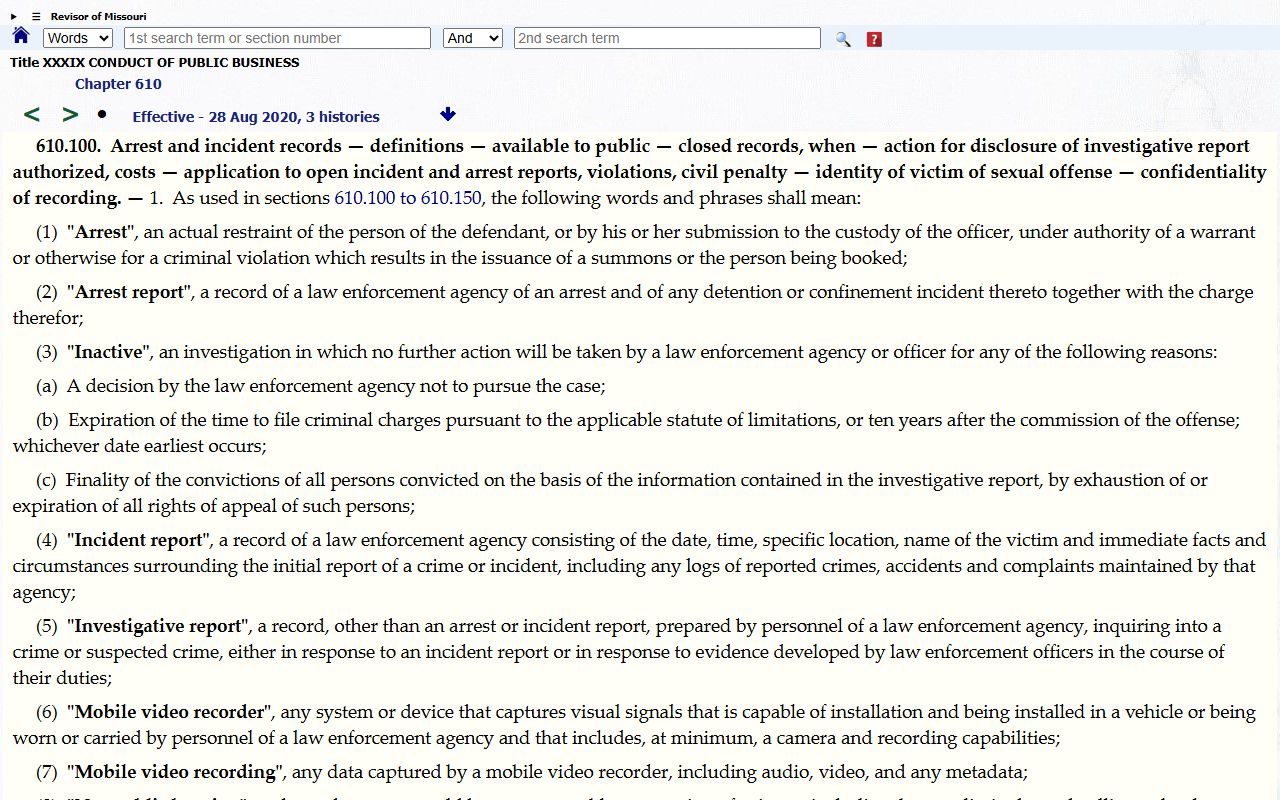
That statute supports the difference between a sheriff record request and a court charge search, which may involve different custodians and different closure rules.
Ozark County Sheriff's Office / Jail
HCR 1 Box 8-1
Gainesville, MO 65655
417-679-4633
Call before visiting because no official public jail roster or visitor entrance page was located.
Statewide Charge and History Lookups
Statewide criminal-history checks are not the same as Ozark County court charge records. The MSHP criminal record check process is used for Missouri criminal-history searches. The MSHP public records request page applies to patrol records such as incident, investigative, arrest, or related patrol-created records.
For active offenders, probationers, and parolees, the research file points to the Missouri Department of Corrections offender search. That system does not replace a county jail custody call. It is a state supervision and custody search for active DOC records, and it may exclude discharged offenders or protected records.
The best route depends on the question: Case.net for court charges, Circuit Clerk for certified court copies, sheriff for arrest or jail records, MSHP for criminal-history and patrol records, and DOC for active state offender status.
Sealed and Expunged Arrest Records
Missouri has separate expungement paths for different record problems. RSMo 610.122 covers certain arrest records when charges were dismissed, nolle prossed, or resulted in a not-guilty finding and other conditions are met. RSMo 610.140 covers qualifying criminal records through a petition process, with exclusions and waiting periods.
The manifest image below comes from RSMo 488.650, the Missouri expungement surcharge statute.
That fee source matters because Ozark County petitioners may need to confirm current filing costs, surcharge treatment, indigence waiver questions, and hearing settings with the Circuit Clerk.
| Comparison Point | Sealed | Expunged |
|---|---|---|
| Public Visibility | Closed from ordinary public access by rule, statute, or order. | Closed from public access after statutory relief is granted. |
| Common Source | Juvenile, confidential, investigative, safety, or court-ordered limits. | Petition process under qualifying Missouri statutes. |
| Public Search Effect | May hide documents or limit metadata. | May remove public access to the qualifying arrest or case record. |
Restricted Charge Records in Ozark County
Not every arrest or charge record is public. Juvenile court and peace-officer records of children are confidential under RSMo 211.321. Active investigations, search warrants, victim information, confidential addresses, minor names, and sealed court filings may be closed or redacted. A Case.net result may show limited data or no document link when those rules apply.
Requests should go to the right custodian. Court charge records and certified court documents go to the Circuit Clerk and Recorder of Deeds. Arrest, incident, jail, and warrant-service records go to the sheriff or the law-enforcement agency that created them. The Missouri Attorney General sample records request form can help structure non-case public-record requests.
Note: A charge entry can change, so always read the latest disposition before treating a charge as final.